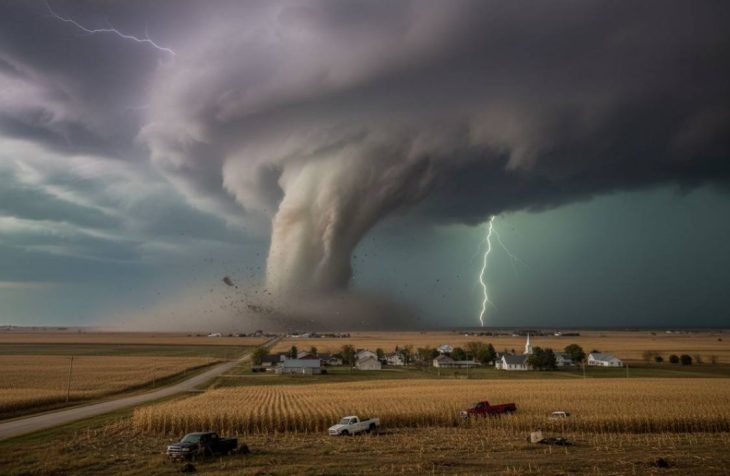
Tornadoes in the United States in 2025: Why This Season Became the Most Dangerous in a Decade
The 2025 tornado season in the United States has already entered meteorological history as one of the most destructive and unpredictable of the past ten years. From record-breaking outbreaks in the Midwest to unusually violent storms in regions that rarely experience strong tornadoes, the scale and intensity of events have raised serious concerns among scientists, emergency services, and the public. This article explores why the 2025 season became so dangerous, what factors aligned to amplify the threat, and how this trend reflects broader changes in climate and atmospheric dynamics.
An Unprecedented Start to the 2025 Tornado Season
The defining feature of the 2025 tornado season was how early and aggressively it began. Tornado activity intensified weeks ahead of the long-term average, with large outbreaks recorded as early as late February. Traditionally, the most active months for U.S. tornadoes are April through June, but in 2025 the atmosphere became primed for severe convection far sooner.
Meteorologists observed a persistent clash between warm, moist air masses from the Gulf of Mexico and unusually strong cold fronts descending from the north. This contrast created ideal conditions for supercell thunderstorms, the type most likely to spawn long-track, violent tornadoes. What made the situation especially dangerous was the consistency of these conditions; instead of isolated events, the U.S. experienced repeated multi-day outbreaks.
States such as Texas, Oklahoma, Missouri, and Arkansas faced relentless waves of storms, leaving communities little time to recover between events. The early onset also meant that public awareness and preparedness levels were lower, as many residents were not yet in “tornado season mode.”
Climate Patterns That Fueled Extreme Tornado Activity
A critical driver behind the severity of the 2025 season was the combination of large-scale climate patterns. While scientists remain cautious about attributing individual tornadoes directly to climate change, the broader atmospheric setup clearly favored extremes.
One of the most influential factors was the persistence of above-average sea surface temperatures in the Gulf of Mexico. Warmer waters increased evaporation, feeding storms with exceptional levels of moisture. This resulted in higher instability, measured by Convective Available Potential Energy (CAPE), which allows thunderstorms to grow taller and stronger.
At the same time, the jet stream exhibited pronounced oscillations, dipping farther south and intensifying wind shear across Tornado Alley and the Southeast. Strong wind shear is essential for tornado formation, as it enables rotating updrafts within storms. In 2025, this shear was not only stronger than average but also more widespread geographically.
The interaction of these elements created a near-perfect environment for tornado development, sustained over weeks rather than days.
Geographic Expansion of High-Risk Tornado Zones
Another alarming characteristic of the 2025 tornado season was the expansion of high-risk areas beyond traditional Tornado Alley. While the central Plains remained heavily impacted, the Southeast and parts of the Midwest experienced an unusual concentration of strong tornadoes.
States like Tennessee, Kentucky, Alabama, and even parts of Ohio reported a higher frequency of EF3 and stronger tornadoes than seen in previous years. These regions are particularly vulnerable due to higher population density, complex terrain, and a larger proportion of manufactured housing.
To better understand how 2025 compared with previous seasons, it is useful to look at key metrics over time.
Before examining the data, the table below summarizes how the 2025 season stands out when compared to the average of the past decade.
| Indicator | 2015–2024 Average | 2025 Season |
|---|---|---|
| Total Tornado Count | ~1,200 per year | Significantly above average |
| EF3+ Tornadoes | ~25–30 per year | Markedly higher |
| Early-Season Tornadoes (Feb–Mar) | Moderate | Exceptionally high |
| Affected States | 15–18 | Over 25 |
| Fatalities Trend | Gradual decline | Noticeable increase |
As shown above, the danger of the 2025 season was not defined by a single statistic but by a combination of higher frequency, broader geographic reach, and increased intensity.
This shift has serious implications for forecasting and emergency planning, as many communities affected in 2025 had limited experience dealing with violent tornadoes.
Why Tornadoes in 2025 Were More Destructive
Beyond sheer numbers, tornadoes in 2025 proved more destructive due to a convergence of environmental and societal factors. Stronger storms alone do not fully explain the level of damage observed across multiple states.
Urban sprawl has expanded into tornado-prone areas, placing more infrastructure directly in the path of storms. At the same time, housing construction in many regions has not kept pace with evolving risk, particularly in areas where tornadoes were historically less common.
Several key elements combined to amplify destruction during the 2025 tornado season:
- Higher average wind speeds within long-track tornadoes/
- Increased nighttime tornado occurrences reducing visibility and reaction time/
- Greater population exposure in suburban and exurban areas/
- Repeated impacts on the same regions within short time frames/
This list highlights that the danger was not purely meteorological. Human factors played a major role in turning extreme weather into widespread disaster.
Nighttime tornadoes were especially deadly in 2025, as warning systems and public response are less effective after dark. Power outages from earlier storms also disrupted communication, compounding the risk.
Challenges in Forecasting and Emergency Response
Despite significant advances in meteorology, the 2025 tornado season exposed ongoing challenges in forecasting and emergency response. While lead times for tornado warnings have improved over the decades, the sheer volume and frequency of events strained both technology and personnel.
In many cases, overlapping warnings created confusion among residents, leading to warning fatigue. When tornado alerts become constant, people are more likely to delay taking shelter, a behavior observed repeatedly during the 2025 outbreaks.
Emergency management agencies also faced logistical challenges. Rapid succession of disasters stretched resources thin, particularly in rural areas where emergency services are already limited. Shelters reached capacity quickly, and damage assessments lagged behind ongoing threats.
The season demonstrated that accurate forecasts alone are not enough. Communication strategies, public trust, and infrastructure resilience are equally critical in reducing tornado-related losses.
What the 2025 Season Signals for the Future
The most troubling aspect of the 2025 tornado season is what it may indicate about future trends. While no single season defines a climate trajectory, the patterns observed align with scientific projections of more volatile weather extremes.
Researchers are increasingly focused on how warming temperatures influence atmospheric instability and moisture availability. Even if overall tornado counts remain variable, the risk of high-impact outbreaks may continue to rise.
Communities, policymakers, and planners will need to adapt by updating building codes, improving warning dissemination, and expanding public education efforts. The traditional boundaries of Tornado Alley may no longer be sufficient for risk assessment, requiring a more national approach to preparedness.
The 2025 season served as a stark reminder that tornado risk in the United States is evolving, and that past experience alone is no longer a reliable guide to future danger.
Conclusion
The tornado season of 2025 became the most dangerous in a decade due to a rare alignment of climatic, atmospheric, and societal factors. An early and aggressive start, fueled by warm Gulf waters and a volatile jet stream, produced widespread and intense tornado activity across an expanded geographic area. Combined with increased population exposure and challenges in emergency response, these conditions resulted in a season marked by exceptional risk and destruction. Understanding why 2025 was so severe is essential not only for interpreting the past, but for preparing for a future in which extreme weather may become increasingly common.